Tuesday, November 30, 2021

Turkey Thicket and the Civil War Comes to Washington, DC


This is a greatly expanded version of an account first published on November 24, 2011 in A Flâneur in Washington, DC.]

Having just enjoyed a long, restful Thanksgiving holiday weekend, it seems entirely appropriate to mention the fact that Washington, DC is home to a small and little known neighborhood known as Turkey Thicket which is located a mile or so from where I am writing this at home just over the District line in Maryland.  I have been driving through it fairly regularly over the past 40 years not knowing it by its old name.  In fact, few people other than those who call it home are aware of it for it is now considered part of the larger University Heights neighborhood adjacent to The Catholic University of America in the Brookland section of northeast DC.    

There has been neither a thicket nor any turkeys to speak of in these environs in even the farthest distant memory yet until the late 19th century this area was still largely hilly woodlands and farms where Washington’s elite would come to escape the heat and humidity of the District’s riverside precincts.  The area now known informally as Turkey Thicket was originally part of the Bellair plantation belonging to Colonel Jehiel Brooks and his wife Ann Margaret, the daughter of Nicholas Louis Queen, a prominent Maryland businessman and one of the largest landowners in the District.    

Brooks (1797-1886) was originally from Albans Province of Vermont and spent most of his boyhood years in Conneaut, Ohio, on Lake Erie east of Cleveland.  He served as a First Lieutenant in the First Regiment of Infantry with the Ohio Militia, in the War of 1812, and later studied law in Cincinnati and was admitted to the Ohio bar in 1823.  He practiced law in Ohio until 1826 when he moved to Natchitoches, Louisiana, south of Shreveport.  He continued to practice law after being admitted to the Louisiana bar in 1828.

Brooks came to the District of Columbia later in 1828 seeking political appointment and married Ann Margaret.  He was appointed governor of the Red River Indian Agency beginning in 1830 during the administration of Andrew Jackson.  The Agency had been established in 1804 in Natchitoches, but during Brooks’ tenure the Agency moved in 1831 from Caddo Prairie to Peach Tree (or Orchard) Bluff, on the Bayou Pierre Channel, south of Shreveport.  Brooks successfully negotiated a treaty with the Caddo in July 1835 after which he and his 
family returned to the District, settling on a tract of land belonging to Ann Margaret known as the "Inclosure" which included Turkey Thicket.  He assumed the role of gentleman farmer and the Bellair plantation’s original Greek Revival-style plantation house was built around 1840 and still stands on the site.

Shortly after returning to the District Colonel Brooks was accused of fraud during his years in Louisiana while he initiated a number of civil suits, almost all of which he lost, concerning land he claimed he had purchased from his Indian charges.  In order to resolve his financial troubles brought on by his legal failures, Brooks petition successive presidential administrations for patronage positions yet his only subsequent public office was that of Supervisor of the District’s Washington County, in 1845.  Washington County, ceded by Maryland in 1790, included all of what is now the present District of Columbia east of the Potomac River.  The original Alexandria County ceded by the Commonwealth of Virginia formed the portion of the District west of the Potomac. It was returned to Virginia by Congress in 1846.

In 1861, as the Southern secession tore the country apart, the
federal government erected 68 temporary fortifications around Washington, including seven earthen and brick redoubts inside the District itself.  One of these, Fort Bunker Hill, was constructed by the 11th Massachusetts Infantry on Brooks’ land.  This drew the ire of the Colonel, who had become an ardent Confederate sympathizer, and he unsuccessfully challenged the government to remove it.  In 1862, the fort was manned by members of the 11th Vermont Infantry whose encampment was situated in the adjacent Turkey Thicket.  The fort was manned until the end of the war in 1865.

It seems few people around here know the only Civil War “battle” to take place within the boundaries of the District of Columbia occurred on July 11-12, 1864 at Fort Stevens, one of the capital’s defensive installations a couple miles northwest 
of Fort Bunker Hill and the Brooks plantation.  Following the Confederate campaign to drive Union forces out of Virginia’s Shenandoah Valley, General Robert E. Lee ordered General Jubal Early and 15,000 troops of II Corps of the Army of Virginia to invade Maryland for a third time with the goal of threatening Washington while disrupting the B&O Railroad.  This move came just 50 years after the British had successfully attacked Washington in August 1814 during the War of 1812.  Early’s corps crossed the Potomac River on July 5 and four days later defeated a smaller Union force from VI Corps of the Army of the Potomac at the Battle of the Monocacy, south of Frederick, Maryland.  Thereafter it continued to advance on Washington from the northwest. 

In the meantime, General Ulysses S. Grant was focused on tightening his noose on the Confederate capital of Richmond and had moved the majority of the 23,000 soldiers assigned to defend Washington, D.C., to join in the siege thereby leaving the capital vulnerable to attack.  With Early now in Maryland and moving ever closer to Washington, Grant withdrew some of his forces deployed near Richmond, just as Lee had hoped.  Fortunately, the delay of Early at Monocacy permitted Grant time to reinforce Union defenses of the capital.

Early arrived on the northern edge of the District on July 11 but did not fully engage the Union defenders until the following day.  President Lincoln and his family happened to be staying at his summer cottage not far from the site of the impending showdown while a steamer waited on the Potomac to evacuate them if the situation became dire as even the White House was less than five miles from the advancing Confederate force.  In the meantime, Marylanders from the surrounding counties began to flock to the relative safety of the city.

The general defense of Washington was dependent on Major General Christopher C. Augur, Head of the Military Department of Washington and in command of the 31,000 largely untried troops of the Union XXII Corps of which less than 10,000 were combat ready.  Early’s troops, on the other hand, were battle-harden veterans.  Major General Alexander M. McCook was now called upon to assume overall command of Washington’s defense from Augur.  Reinforcement ordered from the siege of Richmond by Grant included troops from VI Corps commanded by Major General Horatio G. Wright and a detachment from the XIX Corps commanded by Major General Quincy A. Gillmore which manned the District’s northeast defensive line – Fort Bunker Hill, Fort Totten and Fort Lincoln.  The Union Army's Quartermaster General, Brigadier General Montgomery C. Meigs, commanded the northern line of forts, including Fort Slocum and Fort Stevens, and Augur's XXII Corps, First Division commander, Martin D. Hardin, commanded the northwest defensive line at Forts De Russy and Reno. 

As Wright's VI Corps troops arrived in the District July 11, advanced units of Early's II Corps were approaching from the north.  He delayed his assault on Fort Stevens until his troops had a chance to rest and for him to gather intelligence on the strength of the Union force he was facing.  This additional delay allowed McCook to further reinforce the Union positions with tried and test troops as it appeared they would bear the brunt of the Confederate assault. 

Around 3 pm, with the bulk of their corps present, Confederate infantry and artillery commenced skirmishing, probing the defense maintained by Hardin’s division of the XXII Corps in the northwest quadrant of the District.  The battle skirmishing increased around 5 pm when Confederate cavalry pushed through the advanced Union picket line in front of Fort Stevens.  It was quickly repulsed in a Union counterattack and fighting continued throughout the evening of July 11 as Union artillery shelled Confederate redoubts.

Additional Union reinforcements from the VI and XIX Corps arrived overnight and were placed in reserve behind the line as skirmishing continued on into July 12 with more Union artillery fire centered on Confederate positions in front of Fort Stevens.  When this failed to dislodge the attackers, elements of two Union brigades of VI Corps successfully advanced on these positions at 5pm but with heavy losses.

President Lincoln had personally welcomed the arriving Union reinforcements when they arrived in Washington, and on the morning of July 11 he and a few military aides arrived at Fort Stevens where he was warned to stay under cover as Confederate sharpshooters were already active in the vicinity.  Other than James Madison, who observed the Battle of Bladensburg (Maryland) in August 1814, Lincoln was the only other president to observe combat while in office.  Lincoln eventually returned to the safety of the White House, but later that afternoon he and his wife Mary returned to Fort Stevens.  Standing once again on a parapet to observe the fighting a bullet struck an army surgeon standing next to him and once again Lincoln was forced to take cover while giving a direct order for Union artillery to shell areas where the sharpshooters were positioned. 


It soon became clear to Early that Washington could not be taken without heavy losses.  He withdrew his forces that evening, heading west through Maryland, crossing the Potomac River into Virginia on the morning of July 13.  Early later commented on the battle: “We didn't take Washington but we scared Abe Lincoln like hell." 

The city of Washington began to expand following the war.  Colonel Brooks was involved in another local legal dispute in 1869 when the B&O laid tracks along an edge of his property. The Catholic University of America, situated adjacent to Turkey Thicket and the Brooks plantation, opened its doors in 1887.  Colonel Brooks died at home on February 6, 1886 at the age of ninety.  Marist College, as part of the CUA, took over the mansion and built an addition, and Brooks’ son John Henry (1841-1916), a physician, sold the remainder of the plantation to early 20th century developers for the new Brookland section of the city.  The area generally known as Turkey Thicket was still an open field in the 1930s as new homes and neighborhoods sprouted up nearby.  

The site of Fort Bunker Hill was improved into a park by the New Deal’s Civilian Conservation Corps and later taken over by the National Park Service as part of the District’s Rock Creek Park complex.  Very little of the original fort remains.   A clubhouse was eventual constructed in the nearby field in 1948, and it was replaced in 2003 by the Turkey Thicket 
Recreation Center and Playground.  This is the only reference to Turkey Thicket one will find on a current map of Washington, DC. 

So now you know the rest of the story.

Thursday, November 25, 2021

Fifty Years Ago -- A Very Special Thanksgiving

Thanksgiving is a time to spend with family and friends.  That’s the way it always was when I was growing up; the thought of spending a Thanksgiving alone did not cross my mind when I was young.  I never missed a Thanksgiving with my family until I was twenty years old and attending university in Germany.  
The fourth Thursday of November (the 26th in 1971) had no holiday importance in Freiburg.  I attended my regular classes that day and in the afternoon walked to the local post office to place an overseas call hoping to catch my family celebrating Thanksgiving at home.  I waited for two hours to get a free line and no one answered when the phone finally rang back in Wisconsin.  The holiday and home seemed awfully far away as I walked back to my apartment that evening.  No turkey.  No stuffing with gravy.  No cranberry sauce.  No pumpkin pie.  I settled for a bowl of Hungarian goulash and a couple steins of beer at the Gasthof Sonne, my favorite Stammtisch before hitting the books
But all was not lost and I was not really alone.  Several other American students and I decided, if we could not be home for the holiday, we would at the very least celebrate Thanksgiving with each other on that Saturday (the 28th).  With the campus closed on the weekend we had made arrangements to use a meeting room with kitchen privileges.  Each of us was tasked with shopping trips and preparation assignments, and we each invited a German friend to share our very special thanksgiving with us.
I skipped the one class I had on Friday and a friend who had PX privileges and I made our way to the Freiburg Hauptbahnhof where we caught a train north to Karlsruhe. We changed to another train to the main station in Stuttgart, and from there we took a local train out to Vaihingen where we visited the US Army commissary at Patch Barracks.  We purchased two large (well, large for Germany) frozen turkeys, a few cans of cranberry sauce and pumpkin pie filling (at the time these items were nowhere to be found back in Freiburg), and a few other items that reminded us of home.  I took the opportunity to pick up several boxes of Aunt Jemima pancake mix and large bottles of Log Cabin syrup to stock my own larder.  Who knew when I would next make it back up to Stuttgart?  We were soon retracing our route back to Freiburg where we arrived late in the evening, the turkeys already beginning to thaw.

Early the next morning I brought the defrosted turkeys to our meeting room and all of us began our preparations for the feast to come.   Having been partially responsible for the acquisition of the turkeys, the task of cooking the birds also fell to me and I used my family’s rules of thumb - cook the stuffing separate from the birds and baste only at the very end of the roasting time.  Thankfully we had an oven large enough to accommodate the turkeys, a small ham, and the pans of stuffing. 
Everything was ready by mid-afternoon when we sat down to eat.  I was given the honor of carving the birds and slicing the ham.  A short prayer of thanksgiving was offered up and we toasted our absent families and friends, as well as our new friends who had come to join us.   Better yet, a gentle snow fell throughout the afternoon which helped us enjoy the holiday spirit.  We ate and drank until we could eat and drink no more, and it was late evening by the time I made my way back through the snow to my apartment and fell into bed.
The following day, the 29th, was Totensonntag, the last Sunday before the beginning of Advent.  A mostly German Protestant celebration for the deceased, it is similar to the Catholic celebration of Allerheiligen and Allerseelen (All Saints’ Day and All Souls’ Day) at the beginning of November.  It is normally a day of silence and churches forego music in their traditional liturgy.  The bells of the Lutheran church a block away from my apartment, which normally began to ring early each Sunday and went on for quite some time, did not ring that day.  Still, I managed to arise from bed without the aid of that cacophonous carillon, and after a few cups of coffee to declinate my internal compass and regain my orientation after a night of tryptophan-induced foodmares, I walked through the new fallen snow to the campus to clean up from the day before.    A few others also showed up and we warmed up the leftovers and had a second feast before putting everything back in order.  

That following Monday I returned to my classes and in the late afternoon I made my way again to the post office hoping I might reach my family.  I requested an overseas line, and after another long wait for a connection, I heard that familiar ring of an American telephone.  My dad was still at work, but I had a nice chat with my mother with whom I had not spoken to for over three months.  She told me all about the first holiday celebration I had missed at home, and I told her about my very special Thanksgiving, perhaps the first one when I fully understood the meaning of giving thanks for what I had long taken for granted.  Home suddenly didn’t seem all that far away.

Saturday, November 20, 2021

I Apologize for My Long Silence

I apologize for my long silence.  These past five months have been full of trials and tribulations and unfortunately my postings here have suffered as a result.  I have continued to write, but there has been precious little I was ready to share with the world.   There is a time and a place for everything, but sadly the past few months have not been conducive to sharing.  That said, I am confident the tide has turned and I hope to be posting here again on a fairly regular basis.  The first half of 2021 was productive, and now that I have weathered the lean months, I hope to finish off the year with my attention back on what I have to say.  So thank you for your patience, and stay tuned.

Saturday, June 26, 2021

Comrades in Arms

This photo was taken in Ocala, Florida circa 2005.  These are the last two surviving members of my father's unit during World War II.  Both were awarded the Bronze Star in late 1944 during the Battle of the Bulge.

                Ralph C. Rogers (1924 - 2009)

                Harry E. Kirby (1924 - 2017)

They are buried a short distance from one another at the Florida National Cemetery in Bushnell, Florida.

Comrades in Arms. Friends in Peace. Resting in Peace through Eternity.

Thursday, June 24, 2021

Diversity Wins Outs Over Intolerance

A struggle for European values was clearly evident last night in Allianz Arena, more so than the earlier Euro Championship matches against France and Portugal.   It was more than a sporting even played out on the pitch; it was a battle for tolerance and human dignity and against Europe’s backslide into authoritarianism. 

The Munich city councilors put forward a motion to have the city's Allianz Arena illuminated in rainbow colors for the match between Germany and Hungary after Hungarian lawmakers recently passed anti-LGBTQ legislation which also violates free speech, all of which runs contrary to the stated values of the European Union of which both Germany and Hungary are member states.  However the UEFA, European football's governing body, declined Munich's request stating that the organization is politically neutral and the illumination could be perceived by many as having a political context.  The UEFA should be reminded that the rainbow colors and flags are not of a political nature; rather they represent the importance of racial, cultural, and gender diversity.  As a result of the UEFA ruling, several arenas throughout Germany chose to illuminate in solidarity with Munich and to "fill the void."  Here is the Olympic Stadium in Berlin where Adolf Hitler presided over the games which ultimately demonstrated that  diversity proved stronger than Nazi authoritarianism and intolerance.

Munich Mayor Dieter Reiter called the UEFA decision "shameful" and promised that his host city still planned to send a clear signal to Hungary and the world that Germany and its people stand for tolerance and human dignity for all . . . except for those who practice intolerance.  The city's historic Town Hall, the Olympic Tower, and a large wind turbine adjacent to the arena were to be illuminated in the rainbow colors. Thousands of rainbow flags were also to be distributed to fans as they arrived at the arena.  

Hungary's authoritarian right-wing Prime Minister Victor Orbán announced earlier in the day that despite the UEFA ruling against Munich's plan he was no longer going to attend the match and instead would fly to Brussels where he planned to attend a European leadership summit where I am quite certain he is going to get an earful (and hopefully a swift and solid kick in the pants) from the EU leadership as well as 14 members of the EU who have roundly condemned the Hungarian action as contrary to the organization's values.  Ursula von der Leyen, a former German defense minister and presently the President of the European Commission, called the Hungarian bill “a shame” and promised legal steps against Hungary’s anti-LGBTQ law.  It is difficult to fathom that Orbán would miss attending this particular match which would determine the fate of the Hungarian national team in the European Football Championship.  Deciding to forego his visit to Munich in the face of the anticipated protest again him and his government, Mr. Orbán obviously does not have the courage of his convictions.  Fine.  His kind is not welcome in Germany . . . or anywhere else where democracy and the rule of law are cherished.

Amazingly enough rainbow flags seemed to outnumber German flags when the match began at 9pm.  The so-called Carpathian Brigade, the often confrontational black-clad Hungarian fan base, a fair share of which are members of the country’s alt-Right movements, was expected in force and were warned not to sport neo-Nazi clothing or tattoos which are strictly forbidden in Germany.  Very few of the estimated 2000 Hungarian fans attending the match accepted the proffered flags and they seemed bemused by the entire spectacle.   They should have felt embarrassed and ashamed.

It was a hard fought match ending in a 2:2 draw.  The Hungarian fans are undoubtedly disappointed but they can take pride in how well the team played despite the reality that it has been eliminated from the championship series

The real losers are the cowardly Prime Minister Orbán who almost never misses an opportunity to watch the Hungarian national team play.  At the last minute he decided against traveling to Munich which was geared up to protest the actions of his government.  The UEFA is another clear loser.  Despite claims to support diversity, it has lost its credibility and has been roundly condemned and accused of hypocrisy for denying Munich the right to illuminate Allianz Arena in a show of solidarity with those who are being deprived of their ability to openly express this very diversity.  The UEFA ultimately “came out” and admitted that rainbow imagery is “not a political symbol.”  I am afraid it is a day late and a Euro short.

Germany will go on to meet England at Wimbley Stadium in the next round on June 29, taking with it perhaps Europe’s moral high ground.


Sunday, June 20, 2021

Today is World Refugee Day

World Refugee Day was first celebrated on June 20, 2001, on the 50th anniversary of the 1951 Refugee Convention.  Today marks 70 years!

The day is now observed around the world to draw attention to the plight of refugees, to spotlight the bravery and strength of people forced to flee their home countries to escape war or oppression.  It is time to mobilize political will and resources to urgently help these people rebuild their lives far from their homelands.  According to the United Nations, more than 82 million people are now forcibly displaced worldwide; around half of whom are under the age of 18.

These people are not coming to take your jobs or to steal your country or cultural identity.  They only want to live in peace and safety, and to give their children a chance to thrive.  I have seen refugee camps up close.  You would never want to live like that.   Neither do they.

#RefugeeLivesMatterToo

Happy Father's Day


 Wishing all my fellow fathers a very Happy Father's Day.   I miss my own dad every day.

Saturday, June 19, 2021


We now finally commemorate and honor those who suffered the slings and arrows of the most outrageous fortune with an appropriate national holiday.. Black Lives Still Matter.

Sunday, May 16, 2021

The Other Tea Pot Dome

I was probably around five years old when I first became familiar with Tea Pot Dome, a small rural highway junction in southwestern Michigan.  This was long before I had ever heard of the infamous government scandal beginning in May 1921.  Before the Watergate scandal in the mid 1970s, Teapot Dome was considered to be the greatest scandal in the history of American politics.

Teapot Dome is the prominent butte situated in the Salt Creek oil field north of Casper, Wyoming where oil was first struck in 1889.  It soon became one of the most productive oil strikes in the western United States.  By 1915, a portion of the Salt Creek field (often referred to as Salt Creek Dome and Teapot Dome because of a nearby landmark) was designated a Naval Petroleum Reserve, a federally controlled  oil resource.
The scandal involved Secretary of the Interior Albert Fall, in the cabinet of President Warren G. Harding (1921-1923), and Secretary of the Navy Edwin C. Denby.  Harding appointed Fall as Interior Secretary in March 1921 and shortly thereafter Harding signed an executive order approving Denby’s request to transfer control of the naval oil reserves at Teapot Dome from the Department of the Navy to the Department of Interior.  Fall then proceeded to grant friends in the oil business exclusive rights to drill for oil on this federal land and to control government oil reserves without open bidding; this in exchange for over $400,000 in personal loans and gifts which he used, in part, to expand and improve his New Mexico ranch.

The Wall Street Journal made public these illegal transactions in April 1922.  Following Harding’s death in office in August 1923, Wisconsin Senator Robert M. La Follette urged the Senate to launch an investigation into the oil leases and Fall's actions.  The Senate Committee on Lands and Public Surveys conducted an inquiry and concluded in 1924 that the Teapot Dome leases had been fraudulent and corrupt.  Both Denby and Fall were forced to resign from office as a result.  Fall was convicted in 1929 of accepting bribes becoming the first US cabinet member to be to be found guilty and imprisoned for crimes committed while in office.  He spent one year behind bars.  The Teapot Dome scandal outraged Americans shocked by this unprecedented level of corruption within the federal government and President Harding’s early popularity quickly eroded to the point that he is now considered one of this country’s worse leaders.   

I knew nothing of this major scandal at age five.  For me, Tea Pot Dome was a rural highway junction in Van Buren County Michigan, a landmark as my family drove the 20 miles separating my maternal grandparents’ farm near Paw Paw, and my paternal grandparents’ home in Decatur.  Today it is located at the T-junction of M-51, a 41-mile north–south state trunkline highway extending to  the Michigan–Indiana state line near South Bend, and the Red Arrow Highway.  This east-west route was originally Michigan Highway M-117 until 1926 when it was designated the former US Route 12 in Michigan.  In 1952, segments of this highway in Berrien and Van Buren counties were dedicated in honor of 32nd Infantry Division of the United States Army formed from Army National Guard units from Michigan and Wisconsin which fought primarily in the two World Wars. A red arrow was the divisional insignia and it became popularly known as the Red Arrow Division.  Until 1960, when Interstate 94 was completed across Michigan, it served as the main route between Detroit and Chicago and the highway we always took when we visited from our home in Illinois and later in Wisconsin.  I should note that Michigan became the first state to complete a border-to-border toll-free Interstate highway extending for 205 miles thereby creating the longest toll-free freeway in the United States at the time.

The relatively short distance between the farm and Decatur did not seem so to a young boy sitting in the back seat anxious to get to where he was going.  Since Tea Pot Dome was approximately half way, I was always on the lookout for the junction’s blinking light and the adjacent small black concrete building with a large white tea pot painted on its sides.  Then I would know we were half way to where we were headed.  I thought the name funny, but I never though about its significance until years later when I first learned about the Wyoming scandal.  Even then, I thought it a rather curious point of reference for a rural highway junction in Michigan and I began to wonder if it had anything to do with those events in Wyoming decades earlier.

Just recently, while conducting genealogical research on my Michigan ancestors, I once again began to consider the significance of the reference.  Doing some research into the subject I quickly ran across a recording of a program aired on National Public Radio’s Western Michigan University affiliate WMUK in Kalamazoo a few years ago.  “Why’s That” was a short broadcast telling little known stories about southwestern Michigan.  There had been an inquiry into the origin of the Tea Pot Dome junction near Paw Paw and WMUK had done the groundwork to solve the mystery.  Today there is a familiar green and white highway sign a short distance from the junction (it was not there during my early visits to the area), and the inquirer had wondered if it had some geographic significance.  He did not think this the case; there was nothing else in the area to suggest this.  The area is not incorporated nor does it show up as such on the Van Buren County plat maps.  So does it have something to with the infamous political scandal almost a century ago?   As it turns out, it does.
The story begins in the early 1920s when a Chicagoan by the name of Chris Henderson  left the city on the advice of his doctor and moved to southwestern Michigan, settling with his wife on Lake Cora, just a short distance from the junction.  There he opened the Chris Henderson Service Station providing Texaco gasoline and oil to travelers on the old M-117 between Chicago and Detroit.  And so it remained until the late summer of 1924.  WMUK managed to track down Henderson’s granddaughter in nearby Lawrence, Michigan for the rest of the story.  She told WMUK that she had always heard how her grandfather was discussing the Teapot Dome scandal with a friend that year when the scandal was getting a great deal of press coverage.  They both thought it would be an interesting and catchy name for Henderson’s business.  She did not think her grandfather was trying to make a political statement when he renamed his service station Tea Pot Dome (three words instead of two).  The name stuck and soon her grandmother opened the small Tea Pot Dome restaurant.  Add to this a collection of tourist cottages, a farmers market and baseball field and Tea Pot Dome began to show up on some maps of Michigan although it remains unincorporated.  A roller rink was added some time
in the 1930s and my mother has told me stories of going there with friends to skate and for dances while my father was serving overseas during the war.   Gone today are the service station, the cottages, and the roller rink, but the junction has an official highway sign and the restaurant is still serving food almost a century later
.  

As it turns out, Henderson was not the only individual to associate his service station to contemporaneous events in the Wyoming oil fields.  In 1927, a Dutch immigrant moved to Pentwater, Michigan some 120 miles north of Paw Paw on the shores of Lake Michigan and established a Sinclair Oil service station on Main Street (US Route 31).  He later added a store which together he called Teapot Dome (two words instead of three).  His stepdaughter later told the local historical association that the station and store were named after the famous scandal.  This establishment operated until the mid 1950s when the owner died and the business was sold.   It later operated as a restaurant.   I can’t help but wonder whether the original owner may have passed through the junction to the south on his way to Pentwater and found the name catchy.   I guess we will never know. 

Tuesday, May 11, 2021

Vienna Sausage - A Mystery Encased in an Enigma

During a radio broadcast in October 1939, shortly after the outbreak of World War II, British Prime Minister Winston Churchill described the interests and intentions of Soviet Russia as “a riddle, wrapped in a mystery, inside an enigma.”  This would be my response if I were asked to describe the meat product we know in this country as Vienna Sausage.  Is it really a sausage, and if so, did it originally come from Vienna?

During my first trip to Europe in 1968, and during my student days in Freiburg a few years later, I began a life-long enjoyment of genuine German sausages.
http://lookingtowardportugal.blogspot.com/2020/12/my-wurst-days-are-often-my-best-days.html
But this was not always the case.  In my younger days “sausage” meant one of two things; what we commonly call “breakfast sausage” (links or patties) and, of course, Vienna Sausage, those little meat tubes packed into a round can with aspic and sold here in North America.  But I am getting ahead of myself.
Let us first consider the sausage indigenous to Vienna, the capital of Austria.  Wiener Wurst, or its diminutive WĂĽrstchen or WĂĽrstle - is essentially a long, thin sausage traditionally containing pork and beef encased in sheep intestine and then parboiled  and/or smoked at a low temperature.  Today they are also frequently produced using spiced ham in a very light, edible casing produced from collagen and cellulose.  A first impression is that they look very much like what we refer to as a hot dog as they are traditionally served on a bun with condiments.  In fact, this is were we get the term “wiener” as another name for the traditional American hot dog.  

The “wiener” such as we know it today, originated not in Vienna but in Frankfurt, Germany and the very beginning of the 19th century.  Johann Georg Lahner (1772–1845), a son of a Swiss farmer and a butcher trained in Frankfurt, began in 1805 to produce boiled sausages from a mixture of pork and beef.  At first he referred to his combinations as a "Lahner WĂĽrstle," but later simply call them “Frankfurter" to commemorate where he learned the art of butchering.  He eventually ended up in Vienna where these sausage quickly became a delicacy which over time became know as Weiner WĂĽrstchen, using the diminutive as they were smaller and thinner than other locally produced sausages.  They continue to be sold in Germany as a “Frankfurter” which is yet another term used for the hot dog in this country. 

So how did what we know today as Vienna Sausage in this country come to be?  Is it a sausage originally from Vienna, or is it something more akin to the sausage Lahner produced in Frankfurt before moving to Vienna.  It is a story that remains a mystery within an enigma.  Surely the basic idea arrived in this country with European immigrants.  Perhaps it is only an urban myth, but its origin is frequently attributed to an Archibald K. Wortham who was born in Vienna, Austria and who traveled to this country in the early 20th century.  He worked in a tin-can factory outside Baltimore, and then spent the rest of his life in Vienna, Virginia, outside of Washington, DC.  As early as 1903, "Vienna sausage" came to mean only short smoked and canned wieners.  So I guess the question is . . . are these sausages named after the Vienna in Austria or the town in northern Virginia?   I have been to Vienna many times and I can assure you that I never encountered any concoction closely resembling the small, pasty fingerlings of whatever we call Vienna Sausage.  And what became of Mr. Wortham?  He is buried in Forest Hill Cemetery in Memphis and his grave is marked by a stone in the shape of a Vienna Sausage.   Every year on July 19, his birthday, fans of the mystery meat leaves empty cans on his grave as a tribute.   
Today Vienna Sausage is produced much like hot dogs.  Meat is finely ground to the consistency of paste to which salt, herbs and spices, and chemical preservatives are added.   The mixture was then stuffed into a thin synthetic casing and then thoroughly cooked, cut to size, and canned in a gelatin similar to aspic.  Eventually the casing was abandoned in the 1950s.  They are ready to eat and can also be used in recipes like any other sausage.  Still there is no mistaking them for other types of sausages.  They are distinct in shape and size..
Consumption of Vienna sausages peaked in this country in the 1970s, but has steadily declined since then.   Still, it is not rare to find cans stocked away in the pantry along with SPAM, deviled ham and various potted meats.  This is not to say that Vienna Sausage was not a favorite snack food when I was young, but we often tend to outgrow such hankerings.  But not always.  Even today as I watch my wife make a Vienna sausage sandwich I know I will be the beneficiary of the two or three she will not need which I then eat right out of the can with a dash of mustard. 

As I write this I am reminded of the TV series Bosch and a scene during which a murder suspect on the lam in an abandoned mountain cabin outside LA looks for something to eat and finds a can of Vienna Sausage.  Trying to open it (this was before the easy to open tin was introduced) he becomes frustrated and throws it across the room, draws a large handgun, and in a fit of rage threatens to shoot it.   But he doesn’t.  He eventually opens the can and fishes the meaty tubes from their gelatinous reservoir with his fingers and eats them with relish.  Such is the love-hate duality they evoke.

I also remember reading a couple years ago about a Louisiana man ending up in jail charged with aggravated second-degree battery as a result of a tussle involving  Vienna Sausage.  A neighbor allegedly approached the man, who was confined to a wheelchair, and asked for one of his sausages.  When he refused, the neighbor allegedly struck the man who then pulled a knife.  The neighbor ended up with a cut on the nose and the man’s bond was set at $25,000.  You can buy a lot of Vienna Sausage with that kind of money.

So now you know the rest of the story.   You are welcome!

Friday, May 7, 2021

Another Foodie Ramble Through Montreal

Throughout this pandemic I have become quite the armchair gourmand, recalling past memorable locales and meals with the hope that I will be able to return to them in person for yet another culinary adventure.

A few weeks ago I posted “Following My Stomach Around MontrĂ©al” (March 13, 2021)
http://lookingtowardportugal.blogspot.com/2021/03/following-my-stomach-around-montreal.html
It was difficult to decide what to include; there is so much to choose from in this most unique of North American cities.  Since that posting, the late Anthony Bourdain’s World Travel: An Irrelevant Guide (with Nancy Woolever) has been published by Ecco Press.  MontrĂ©al held a special place in Bourdain’s heart and it was the focus of several episodes of his various television projects.  “The people who live there are tough, crazy bastards, and I admire them for it.”  And the best reason to visit the city?   The food!!  I can only say “amen” to that.
I have visited three of the four venues mentioned in Bourdain’s section on MontrĂ©al, and two of them - Schwartz’s Hebrew Deli and Marc Picard’s Au Pied du Couchon - are highlighted in my previous posting.  “I don’t really know what MontrĂ©al is like for normal people  What I can tell you is that, for chefs, it’s notoriously a very dangerous place.”  Bourdain was richly wined and dined during his visits and knew of what he speaks.  “MontrĂ©al is a chef town.  It’s a stay-up-late-and-have-a-good-time town . . . yet always with panache.”

So I have decided to take another vicarious day ramble through one my own favorite cities to sample some other favorite locales that did not make the first cut . . . simply for the fact that MontrĂ©al is a city of culinary riches.  And I may have to do this again at some future point in time.  It is a tribute to all MontrĂ©al has to offer to one in search of something tasty to eat and drink.  

This time I am limiting myself to my favorite part of the city . . . the borough of Le Plateau-Mont Royal and its Plateau and Mile End neighborhoods northeast of downtown.  What’s not to like about these bohemian neighborhoods with their brightly colored shops and residences; and the book shops, galleries, boutiques, music venues, and to top it off, a wide variety of eateries, sidewalk cafes, and watering holes to please everyone’s palate.  The streets are always crowded and one can sense the heartbeat of the city.  These are certainly among the hippest neighborhoods in North America in my humble opinion. 
So where to begin?  There are so many possibilities  I have never been much for a heavy breakfast and so I am happy to score some good coffee and a pastry or bagel.  I select CafĂ© Iso at 251, Avenue Duluth Est (at the corner of rue Laval).   After an early coffee upon rising for the day, I wander here for something a little more substantial.  I select a cappuccino and a bagel dĂ©jeuner – a fried egg, cheddar, bacon, lettuce, tomato, with mayo Ă©picĂ©.  There are lots of windows and it is a perfect spot to watch the city come alive while thumbing through Le Journal de MontrĂ©al. 
After breakfast it is a short walk over to Boulevard Saint-Laurent - Le Main - for a slow ramble through MontrĂ©al’s historic Jewish quarter.  The Museum of Jewish MontrĂ©al is situated at the corner of Saint-Laurent and Duluth and it tells the rich story of the community.  This neighborhood was at one time the home of Mordecai Richler (1931-2001) whose novels are frequently set here, Leonard Cohen (1934-
2016), Saul Bellows (1915-2005) who later lived and wrote in my home neighborhood of Humboldt Park in Chicago, William Shatner, and many others.  Adam Gopnik, the American-born essayist and staff writer for The New Yorker, was raised here and attended McGill University.  On my route I pass by two iconic establishment - Schwartz’s Hebrew Deli and Main Deli across the street, both of them known far and wide for their smoked meats.  I featured Schwartz’s for lunch in my earlier MontrĂ©al ramble.
http://lookingtowardportugal.blogspot.com/2021/03/following-my-stomach-around-montreal.html
Parc des Ameriques at the corner of rue Rachel Est is a pleasant spot to sit and rest and gather one’s thoughts, or to read for awhile in the shade of its many trees.  A couple blocks further on is Parc du Portugal and Leonard Cohen’s former home just across the street at 28, Rue Vallières.   This is the heart
of the Greek and Portuguese communities.  Continuing north I pass into the Mile End neighborhood which was the main Jewish neighborhood until the mid 20th century.  There is still a Hasidic Jewish presence although this has undergone gentrification over the past 30 years and it has not remained as bohemian as Le Plateau. 
What better place to head for a light lunch than Wilensky’s at 34, Avenue Fairmount Ouest (at the corner of rue Clark).  A landmark in the Mile End neighborhood since 1932, it was originally located at the corner of rue Saint-Urbain and Avenue Fairmont.  It has been at its present location since 1952 and has changed very little in the intervening seven decades.  Still owned and operated by the Wilensky family, it was originally known as Wilensky’s Light Lunch, but it dropped the English in response to QuĂ©bec’s Official Language Act of 1974 and the subsequent Charter of the French Language (also known as Bill 101) in 1977 which mandated French as the only language for advertising and education in the province.  But the food is still the same no matter what language you order it.   And there is only one thing to order . . . the Wilensky Special / SpĂ©cial Wilensky® . . . and you can’t go wrong.  It
consists of slices of grilled all beef salami and baloney on a Kaiser roll which is then heat pressed on the original 70 year old press.  It is served piping hot with a swipe of mustard (always!!), a pickle wedge, and a house prepared cherry soda.  They also serve hot dogs on an open face roll and fried egg sandwiches.   The famous and the infamous have been coming here for almost 89 years and it seems everyone come for the Special.  Mordecai Richler was a regular patron and Wilensky’s is mentioned in two of his novels – The Apprenticeship of Duddy Kravitz (1959 - it was also featured in the 1974 film based on the novel starring Richard Dreyfuss) and Solomon Gursky Was Here (1989).

It seems a shame if a foodie’s ramble through MontrĂ©al should not include a sampling of its rich ethnic offerings.  This time I return to Le Plateau and 73, Avenue Duluth Est and Au Coin Berbère, a restaurant specializing in North-African cuisine.  This street has long been known for its eclectic ethnic
foods and one can certainly not go wrong here.  Rarely have I enjoyed ethnic food in Au Coin Berbère’s opulent setting.  This restaurant does not serve alcohol but one is welcome to bring a beverage of choice.  I select a wonderful Cinsaut-Syrah blend from Tunisia and it turns out to be an excellent choice.  I have eaten rather lightly during the day in order to pull out the stops at dinner.  I begin with a bowl of chorba, a traditional soup with bulgur and spiced with coriander accompanied by a small bowl of kalamata olives drizzled with cumin-infused olive oil.  Everything smells just as good as it tastes.  I
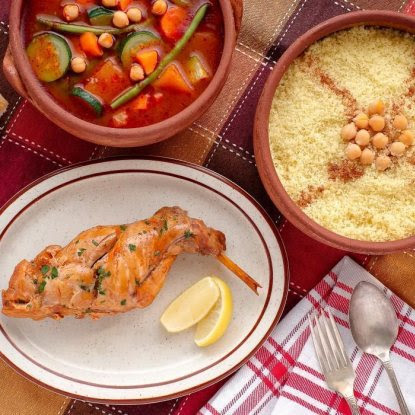
make sure I leave plenty of room for the entree with is served with a light fine-grain couscous exuding a faint aroma of anise.  Entrees include lamb, beef, Merguez sausage, and mechoui (lamb roast) but this evening I choose the couscous au lapin du QuĂ©bec (a savory portion of local rabbit).   This is certainly a place I will return to.   There is so much on the menu too tempting to ignore.  
After a full day wandering these two marvelous neighborhoods it is time to return to Mile End for a nightcap at Dieu du Ciel, a popular brewpub for the past 20+ years at 29, Avenue Laurier Ouest.   It has a generous selection of brews and I order a couple pints of the Kilomètre ZĂ©ro, a light IPA, to settle the day’s dust as I reflect on all that I had enjoyed while dreaming of where my next ramble might take me.  I will never tire of wandering MontrĂ©al in search of good places to eat and drink.