Monday, November 26, 2012

A Town Called Romney

In the wake of the recent national election extravaganza which, in my humble opinion, went on way too long, my fellow road warrior Michael G. Stewart and I recently set off in the pre-dawn hours on a long anticipated road trip across a scenic swath of central Maryland and the West Virginia panhandle.  I also thought it might be fun to visit Romney, West Virginia with the idea for a post election blog with little or no politics in it.  Why not visit a town that shares it’s name with one of the presidential candidates?  Romney seemed the best bet since Obama, a city located in the Fukui Prefecture of Japan, did not seem a practical choice.

Our trip first took us across the undulating Maryland Piedmont Plateau, from the northern outskirts of the Washington, DC metropolitan area, past Frederick, to Harpers Ferry, the easternmost town in West Virginia situated at the confluence of the Shenandoah and Potomac rivers in the northern Blue Ridge Mountains.  This entire area is rich in Civil War history, and West Virginia owes its statehood to that conflict.

Cutting across the narrow eastern neck of the West Virginia panhandle we passed into Virginia and we soon found ourselves in Winchester and the northern reaches of the Shenandoah Valley.  Michael and I were here on a road trip about this time last year and so we did not tarry here long.  A few miles west of Winchester on US Route 50, also known as the  Northwestern Turnpike, is the tiny unincorporated town of Gore, another locale sharing a name with a prominent political figure of the recent past, situated in the Valley and Mountains region of northern Virginia.  Gore lies in Back Creek valley and serves as the western terminus of the Winchester and Western Railroad which runs via Winchester and Martinsburg, West Virginia, to Hagerstown, Maryland.  The American author Willa Cather was born here in 1873 and her birthplace, and her childhood home in nearby Willow Shade, survive to this day.  The family moved to Red Cloud, Nebraska, in 1873 and Cather’s writings are associated with her later life on the Great Plains.

Departing Gore we passed over several eastern ridges of the Allegheny Mountains and soon arrived in Hampshire County, in the Potomac Highlands of West Virginia.  We cross the Cacapon River at Capon Bridge, and continued through lilliputian Augusta, Pleasantdale, Shanks and a handful of other hamlets before we arrive at our destination.

Romney, with a current population hovering around 2000, is situated on the South Branch of the Potomac River and is the seat of Hampshire County. It shares the claim to being the states’s oldest town with Shepardstown, over in the eastern panhandle, having been settled by trappers in the early 1720s when it was first known as Pearsall's Flats.  Nearby are the sites of Fort Pearsall, Fort Kuykendall and Van Meter Fort, dating from the 1750s and the French and Indian War.  The town was formally chartered and incorporated on December 23, 1762 by Thomas, Lord Fairfax of Cameron who renamed the town Romney in honor of one of the five English Channel ports in Kent.  As far as I can ascertain, the town has no historical or genealogical associations to the ancestors of George and Mitt Romney.  It did, however, vote for Romney in a 2-1 margin over Obama reflecting the town’s current voter registration.

Driving and walking around Romney, which is celebrating its 250th  anniversary this year, it is difficult to understand what drew people to the area, or why they have stayed.  There does not seem to be much going on.  It is the country seat, as well as the home to the West Virginia Schools for the Deaf and Blind dating back to the late 19th century, but other than that it is just a small shire town where local folks come to do their business.  Still, I love to visit small places with big histories.

On May 23, 1861 the citizens of Virginia voted in a statewide referendum to approve the Ordinance of Secession and join the Confederate States of America. Although Hampshire County voted almost four to one to approve Virginia’s ordinance of Secession in 1861 while raising monies to support the Confederate war effort, it was among the several northwestern counties of the Old Dominion that subsequently chose to secede from Virginia and the new state of West Virginia was eventually admitted to the Union on June 20, 1863.  Nevertheless, a vast majority of the local men chose to wear the gray and butternut.

No Civil War battles of any lasting significance took place in or around Romney which is situated astride a natural invasion route to the Shenandoah Valley, to the south, and to the main stem of the Potomac River and the adjacent C&O Canal and B&O Railroad, to the north.  General Thomas “Stonewall” Jackson conducted a campaign in this area in January 1862, severing Union transportation routes along the Potomac north of here.  Scourged by both the Federal and Confederate armies, the town, with a wartime population hovering around 450, changed hands 56 time between 1861 and 1865.

Romney is perhaps significant for Civil War history by the fact that one of the very first Confederate war monuments anywhere in the United States was erected in the town’s Indian Mound Cemetery on September 26, 1867.  It stands there today flanked by Old Glory and the first Confederate national flag (used until 1863 when West Virginia seceded and joined the Union).  The cemetery, named for the ancient Native American burial mound found there, is the original site of Fort Pearsall and the final resting place of many of the soldiers, mostly Confederates, who died in and around Romney during the war.  Many of them, as their markers state, are known only to God, and their graves were decorated with small Confederate flags when we visited.  Also buried here are two former governors of West Virginia, a former Secretary of the Army, several state politicians and local notables, and a former owner of the Washington Redskins.  We wandered around the cemetery taking note of some wonderfully carved tombstones.

The town’s architecture is a mixture of old and new.  The stately neoclassical courthouse in the center of town, was erected in 1922 to replace the original 1833 brick building on the site which burned the previous year.  The oldest structure along Main Street is the Davis House (now the Davis History House), a log cabin erected circa 1798.  It was truly a house divided; the Davis family sent three sons to fight for the Confederacy although one later joined the Union army.  It is now a Civil War era museum operated by the adjacent county library.  Unfortunately it was closed the day we were there.  A few doors up Main Street is the Literary Hall.  Constructed in 1870 to replaced the first Literary Hall (1825) destroyed in 1862, it was the home of the Romney Literary Society established in 1819. Prior to its destruction during the Civil War, it contained the largest library west of the Blue Ridge Mountains.  The Society also established the Romney Classical Institute on the eastern edge of town in 1846.  Its campus was eventually sold to the state for the deaf and blind schools, and the Society disbanded in 1886.  The building is now a museum (also closed that day).  Liberty Hall (1858), on Main Street, was Stonewall Jackson’s headquarters in Romney. 

We enjoyed a nice lunch at Shirley’s Diner, just off Main Street on Marsham Street.  The small building housing the diner was originally Cresap Creamery, and later a saddle and tack shop and a taxi stand.  The sign over the door reads “Come a stranger, leave a friend”.   The food was good and the service fast and friendly.  A nice way to end our visit to Romney.

We took a different route home, making our way to the small hamlet of Paw Paw, West Virginia.  Located on a bend of the main stem of the Potomac River, it was once a thriving town along the B&O Railroad and the C&O Canal and its nearby Paw Paw Tunnel, and home to a large tannery that operated here in the 1930s. George Washington use to pass through this area when he was a member of the party surveying this region for Lord Fairfax. There is not much here to speak of today, and we turned westward following the Cacapon River and crossing the Appalachian ridges to Berkeley Springs (originally Bath for the natural springs located here), another West Virginia town with a close association with George Washington and his family who were some of the first landowners in this area.

Driving north we crossed the Potomac at Hancock, Maryland and set our sights for home.   After dropping Michael off I pulled into the garage thirteen hours and over 300 miles later.  A good road trip for sure.

Sunday, November 25, 2012

4th Anniversary of "Looking Toward Portugal"

Four years ago today I launched this blogspot with the following post: I have been kicking around the idea of starting my own blog. For a long time now I have been reading those of others and so I think it is time for me to chime in. I will try to update this every week, or whenever the inspiration comes. So stay tuned.

Just a few days ago I passed the 75,000 hit threshold for the 200+ postings to date! I had no idea when I began this site it would be as successful as it has become.  Above all, it is a satisfying outlet for all the things I have chosen to write about over the past four years.  I still have a lot more to say and I am not going anywhere.  I hope you will join me in the coming weeks and months as I continue to share my random notes from the edge of America.  So stay tuned.

Thursday, November 22, 2012

49 Years Ago

This is not the first time I have written on this subject, but sitting here on this beautiful, sunny Thanksgiving morning, I am reminded of a darker time almost a half century ago.

I was sitting in my 7th grade math class in Asheville, North Carolina when the principal’s static voice came out of the classroom squawk box mounted over the blackboard. President Kennedy had just been shot in Dallas.  “I’ll keep you posted” he told us as he asked us to return to our studies.  How was that possible?  A short time later the bell rang and we moved to our next class.  In my case, it was art appreciation.  As I arrived in that classroom our teacher walked in, eyes red and tears streaming down her face.  “The President is dead.”  Classes were dismissed early on that clear, late autumn Friday afternoon.  I grabbed the books I would need for the weekend and I caught the bus home.

When I arrived my mother was crying, watching the news from Dallas.  There, for the first time, I saw those now iconic images of Walter Cronkite replaying on our black and white television.  White shirt and dark tie, with papers scattered around him, trying to make sense of the conflicting reports out of Texas.  Of course I already knew the outcome, but watching those replayed images of Cronkite I thought maybe it was OK.  Maybe the president had survived.  Then came that image I will never, ever forget.  Cronkite taking his glasses on and off . . . those thick-framed glasses . . . as he told us of blood transfusions being given to the stricken president, of a Catholic priest being called to the emergency room at Parkland Hospital to administer the Last Rites.  Later he shared Dan Rather’s report from Dallas saying that President Kennedy had, in fact, died. Then came that moment when Cronkite put his glasses back on and ran a finger quickly along the edge of his nose.  A pause as he removed his glasses again, looking at a studio clock as he told us what we already knew.  From Dallas, Texas, the flash, apparently official: President Kennedy died at 1 pm Central Standard Time. 2 o'clock Eastern Standard Time, some 38 minutes ago.  Trying hard to keep his composure Cronkite went on to tell how the ship of state would continue to function.  It was a lot for a twelve year old boy to grasp.  Thinking back on it today . . . 49 years later . . . it is still difficult to grasp.

Over the next three days the American people were flooded with lasting images as the nation, shrouded in grief, said farewell to its leader, and perhaps to its innocence.  The muffled drums, the riderless horse with the boots turned backwards in the stirrups, the crowds in the streets as the cortege passed down Pennsylvania Avenue, a young son saluting his father for the last time, the broken note as a bugler played “Taps” at the hillside grave in Arlington National Cemetery.  Those who watched will never forget them.

Now . . . finally . . . it all seems so long ago.  But will we ever really forget?

Wednesday, November 21, 2012

Wishing Everyone a Happy Thanksgiving!

Wishing all of you a happy and festive Thanksgiving holiday with family and friends wherever you happen to be.  Please travel safe.

Friday, November 16, 2012

Being a Haligonian for a Day

 I launched this new poem last night at a reading at the Nora School, in Silver Spring, Maryland.  

                             HALIFAX
                     walking along
                    Gottingen rain blows
                    hard & cold
                    she touching hands
                    whispering cryptic
                    words so gently
                    what is this place
                    why are we here
                    walking along
                    wet pavement
                    Gottingen in the rain
                    song says winter
                    is so cruel here
                    into a Sally Ann
                    seeking warmth
                    for heart & soul
                    nothing there for us
                    walking along
                    Gottingen rain blows
                    hard & cold

Tuesday, November 13, 2012

Two New Poems . . . .

I launched these two new poems on Sunday evening at the Iota Club & Cafe, in Arlington, Virginia.

http://ruesansregret.blogspot.com/2012/11/looking-for-linda-hinkley.html

http://ruesansregret.blogspot.com/2012/11/for-christian-petzold_13.html

I will be be a featured reader at Iota along with Jonathan Vaile on December 9 at 6pm.
http://www.iotaclubandcafe.com/

I will also be reading at the Nora School in Silver Spring, Maryland this Thursday evening at 7:30pm.
http://www.nora-school.org/

I hope to see you there.

Sunday, November 11, 2012

Celebrating Our Nation's Veterans

To our fathers and mothers and friends, and to all the men and women who have served in uniform . . . our sincere and deepest gratitude for your sacrifices. Our country celebrates our soldiers and veterans. I only wish it took better care of them.

Tuesday, November 6, 2012

America's First Precinct

The Ballot Room in the Balsams Resort Hotel in 2010
The Ballot Box
I always enjoy writing about the North Country of New Hampshire.  I have written lovingly of the time I have spent in Maine each summer, but when it really comes down to it, it is the rolling forested hills of Northern New Hampshire, its myriad lakes and streams, that are  true God’s Country for me. I would like to thank my friend Donna Jordan, the managing editor of the Colebrook Chronicle, the voice of the North Country of New Hampshire, who provided me with a running commentary of last night’s balloting in Dixville Notch.  Thanks, too, to Chronicle reporter/photographer Angie Wheeler for the photograph appearing at the end of this posting.  Now the rest of the story . . . .
__________

“The Epicenter of America” - this is what the Granite Staters would have us believe about the great state of New Hampshire.  This could have been the case earlier this year when several prospective Republican presidential candidates were tripping over each other on the chicken dinner circuit in the weeks and days leading up to the first Presidential primary in February (the date remains  flexible to insure that it remains the nation’s first primary).  The eyes and ears of the country - even the world - were attuned to what this gaggle of candidates was promising to the sometime taciturn inhabitants of this small and relatively sparsely populated patch of New England.  Each candidate in turn told the local folks why he or she should be the next President of the United States.  Each hoped that by winning the New Hampshire primary he or she would become the heir apparent to the Republican nomination.  The Democrats didn’t have to fight over New Hampshire this time around having already decided to anoint President Obama for a second term.  The political obituary writers were already sharpening their quills.

Every four years the first Granite Staters, indeed the first Americans, to cast their primary and general election ballots are the small handful of registered voters in the  hamlet of Dixville Notch which is situated in the rooftree of New Hampshire just a few miles below the Canadian border.  They assemble in the waning hour of the day before the primary and general, and at the stroke of midnight they cast their ballots.  New Hampshire state law provides for the closing of a poll once all registered voters have cast their ballots.  The votes are tallied, the results posted, and everyone goes home to bed having done their civic duty. 

This tradition was begun in Dixville Notch during the 1960 general election when Richard Nixon won all nine votes cast.  And it continues to this day, having correctly predicted every Republican nominee since then.  The balloting has taken place in numerous locations; at the latex rubber products company found by Neil Tillotson, as well as at the adjacent Balsams resort hotel which Tillotson bought at auction in 1954.  It is Tillotson who is credited with creating the midnight voting tradition at Dixville Notch which was incorporated for the singular purpose of allowing local citizens to vote near home rather than travel dozens of miles to the polls.  In 1948, a neighboring community, tiny Hart’s Location, began its own midnight voting tradition which continued through the 1964 election.  It resumed this voting in 1996, but it is Dixville Notch, with fewer inhabitants than its neighbor, which completes its balloting so quickly and therefore continues to lay claim to “First in the Nation.”

In more recent years the local voting has been held in the wood-paneled Ballot Room in the Balsams Resort Hotel proper, a small room adorned with photographs of previous candidates, both winners and losers, and other election memorabilia. This past February midnight primary voting took place there despite the fact that the hotel had been sold by the Tillotson family last year and later closed for major renovations. There were nine registered voters, a lot fewer than previous years -  three Republicans, two Democrats and four undeclared voters (there are no “independent" voters in New Hampshire, only “undeclared.” There is a national  Independent Party, which is not recognized as an official party in New Hampshire). When the magic hour of midnight arrived, they cast their open primary votes in less than a minute and the polls closed.  Former Massachusetts Governor Mitt Romney and former Utah Gov. Jon Huntsman each won 2 votes .  Former House Speaker Newt Gingrich and US Representative Ron Paul (R-Texas) each received 1 vote. Even thought there was no official Democratic primary this year, the three ballots were cast for President Barack Obama. 

Last night the voters of Dixville Notch reassembled to cast their ballots in the general election.  With most of the contents of the historic Ballot Room preserved and stored away until the hotel renovations are completed and the hotel reopened to the public, including a new Ballot Room, the now ten registered voters braved snow covered roads as they gathered shortly before midnight at the Balsams Wilderness Ski Area .  Voting booths, one for each voter, were set up for the balloting.  A few items from the old Ballot Room were on display to maintain some of its former ambiance.  The name of each voter was placed into a pot and names were pulled to determine the order in which each voter cast his or her ballot.

I sat in front of my TV here in Maryland watching CNN and awaiting a live feed from Dixville Notch while monitoring regular Facebook postings by my friend Donna Jordan, the managing editor of the Colebrook Chronicle, who was reporting from America’s first precinct along with fellow members of the Fourth Estate from all over the world.  Even Chinese television, and CBC from north of the border just 20 miles to the north, were there to tell the story of ten Granite Staters exercising their franchise as Americans. Donna reported that everyone was snacking on sandwiches, brownies, fruit and cheese platters, and drinking coffee and trying to grasp a little warmth from a couple of turbo-shot heat blasters brought in for the occasion.

While President Obama and Governor Romney were giving their final campaign speeches elsewhere, each of the Dixville Notch voters were in their individual booths awaiting the countdown to midnight.  In the final minutes all of the heaters were turned off so that folks could hear what was going on.  “All the media are wicked quiet,” Donna reported as the last minutes ticked off.  She had never seen so many camera phones and laptops in Dixville Notch.  Truly the eyes of the world were focused on this makeshift ballot room.

The midnight hour struck and there was a CNN reporter broadcasting live from Dixville Notch.  Each of the 10 voters left their voting booths and placed their paper ballots in a large wooden box.  In less than a minute the polls were closed, the ballots retrieved from the box and quickly counted, and the results for President and Vice President, Senate and the House of Representatives posted.  For the first time since 1960, it came down to a tie with five votes each cast for President Obama and Governor Romney.  For the record, nearby Hart’s Location reported its results after Dixville Notch.  There Obama received 23 votes to Romney’s 9 with one vote cast for Libertarian candidate Gary Johnson.  Prior to last night’s balloting, the voters of Dixville Notch had a 7-6 record of picking the eventual winner of the general election. It has historically voted 11-2 Republican although in the 2008 election, the vote was 2 to 1 in favor of Barack Obama over John McCain.  The results of this year’s general election are still to be tallied.

This morning I waited for one and one half hours to cast my vote.  I waited until 11am thinking the lines might lessen from earlier in the morning.  Such was not the case.  In fact, the line of voters was even longer when we left the polls. I must admit that I have never seen this many people at the polls for any election I have ever participated in, and I have voted in every election since 1970!  Standing in line, I thought how wonderful it would be to vote in Dixville Notch.  I also thought . . . . how wonderful it is that this many people have exercised their right to vote regardless of the wait involved.


2012 General Election at Dixville Notch [Angie Wheeler/Colebrook Chronicle]

Thursday, November 1, 2012

It's Time to Stand Up and Be Counted

The last thing I want to do is turn this blogspot into my own personal political bully pulpit.  I am not endorsing any candidate for any office in the coming general election; one’s votes are a personal choice and no one need feel compelled to justify that vote.  That said, I want to encourage everyone to get out to the polls next Tuesday (or vote early, if you can, or send in your absentee ballot before the deadline) and make your vote count!  Don’t let a few make important choices for the many.  Voting is a right we should ALL exercise.  See you at the polls.

Tuesday, October 30, 2012

After Sandy . . . .

After the Storm (circa 1877) by Antoine Vallon
O thou afflicted, tossed with tempest, and not comforted, behold, I will lay thy stones with fair colors, and lay thy foundations with sapphires.   Isaiah 54:11

Monday, October 29, 2012

October Fishing


Wooden boat expert Llewelyn Howland probably said it best.  “Everyday on a fishing boat it’s a little theater.  There’s blood.  It’s a self enclosed world.  It’s womb-like.  Time is different.  Time begins at dawn and ends at sunset.  Here is a perfect time on a boat.  You’ve had a long, hard day, you’ve caught your fish, and now you’re purring home, toward your mooring.”  That describes this past Saturday to a tee as I joined good friends for our fall outing on the Chesapeake Bay in search of rockfish (striped bass).  Our spring outing in early May when we trolled for trophy rocks had been disappointing.  An  early spell of warm weather interrupted the normal biorhythms of the fish. http://lookingtowardportugal.blogspot.com/2012/05/ning-dreams-of-rockfish.html

Reports so far this fall had been quite promising and anglers were encountering a mix of rockfish and bluefish in a wide variety of fishing situations in the middle region of the Chesapeake below the Bay Bridge linking Annapolis with Maryland’s Eastern Shore.  So with the arrival of Hurricane Sandy just two days away we set out in the early morning hours from Knapps Narrow, on Tilghman Island, and watched the island’s lights dim on the horizon as we navigated south to the expansive mouth of the Eastern Shore’s Choptank River.

Here we paused in almost 30 feet of water and fished bloodworms to catch several dozen 4-7 inch spots - also known locally as croakers - which we would use for bait (although spot are a tasty fish in their own right).   These fish can often be found in shallower inshore waters but recently they had gone deep and begun to migrate south as colder weather approached.  Our first stop was a brief one as we were only catching small 6-10 inch sub-legal (under 18 inches) rockfish.   So we moved a bit south and soon we were situated near buoy #10 [see map] in a patch of water rich in spot feeding right on the bottom.  Before long our bait barrel was brimming with spot.

With the sun beginning to rise we were soon churning out of the mouth of the Choptank River toward a fishing ground east of the main shipping channel known as the Clay Banks [see map] where there were reports of rock mixed with blues.  We were curious how the approaching storm from the south might affect the fishing in the Bay.  There were already a few boats, mostly from the Western Shore, on the grounds when we arrived.  There were trollers, some with outrigged planing boards to keep the lines away from others, while other boats were anchored and live-lining bait.   There were lots of sub-legal rocks mixed in with “chopper” bluefish up to four pounds.  This time of year there is a personal two fish limit for rocks 18 inches and above with only one allowed to be over 26 inches . . . unlike the spring trophy season when one is permitted only one fish over 28 inches.  As the strong flood tide began to ebb we saw more nice rocks in the 18-24 inch range.

Live-lining takes concentration, unlike trolling where you sit around and wait for a fish to hit one of the lines.  This is hands on fishing requiring one to monitor how far out the line is running and at what depth, trying to keep the bait - a live spot - down near the bottom where the fish are feeding.  Once there is a strike, which can be a very subtle tapping, the natural inclination is to strike and set the hook.  Yet given the size of the baitfish, it is necessary to allow the rock to get it all the way in its mouth.  Strike too soon and all you retrieve is a dazed and confused and rather “manhandled” spot.  Patience pays off.  On the other hand, if a bluefish strikes and you wait, all you will have in the end is a well “apple-cored” spot.  So how can you differentiate between rockfish and a bluefish strike?  You can’t.  That’s why it can be so frustrating at times.  And why it is a challenge and why we like to fish the Chesapeake Bay.

This kind of fishing takes concentration.  It is a virtue not to talk unnecessarily.  It is a matter of luck, or superstition.  If you talk too much, you divert attention from more important things.  There is time for talk while en route to and from the fishing grounds.  Some fish outings can become rather competitive; who can catch the most and largest fish.  I and those with whom I choose to fish see it more as a competition with oneself. How can I prove that someone with a postgraduate education can outsmart a fish with the brain the size of a small pea?  It ain’t easy . . . that’s for certain.  This trip we were lucky and by early afternoon we had caught our limit of rockfish and had several nice blues in the cooler, all nestled in a bed of ice diamonds for the trip back to Tilghman Island. 

An unusually strong tide due to an almost full moon coupled with the approaching storm and the water levels throughout the Bay were much higher than usual.  The developing offshore low pressure system associated with Hurricane Sandy (still almost 600 miles to the south) brought ever stronger winds from the north throughout the day and we had heavy rolling seas smacking our bow square on as we labored our way back to Tilghman Island.  We noticed several crabbing boats gathering their pots.  Everyone is taking Hurricane Sandy very seriously.

Last night I smoked the bluefish and today I am fixing the rockfish for lunch.  And now that the predicted and promised tropical storm winds and rains have reach us here in Maryland, I would not want to be out on Chesapeake Bay this week.  The rockfish and the bluefish (even the spot) can rest easy for a few days.  But once the storm passes, the boats will be out and about until the season ends in mid December.  Then it will be a long winter until the trophy season arrives again in April. 

Sunday, October 28, 2012

Shelter From the Storm

The US National Hurricane Center is presently forecasting giant Hurricane Sandy - the so-called “Frankenstorm” - to track to the northeast from its current  position well off the North Carolina coast.  It should then shift to the northwest and make landfall along the southern New Jersey coastline tomorrow and through the following day.   The National Weather Service in Baltimore has issued a High Wind Warning for the Mid Atlantic States, including Maryland and the metropolitan Baltimore and Washington, DC areas, beginning at 8am on Monday (October 29) and extending into late Tuesday at the earliest.  Wind gusts over 45 mph are expected by early Monday,  and up to 60 mph on Monday afternoon and into Tuesday.  We are being advised to expect a prolonged 24-to-36 hour high wind event coupled with heavy rains leading  to significant tree damage and widespread power and communication outages. 

I will post a full report on the storm once it has passed and the power has been restored.  In the meantime I am battening down the hatches.  Stay safe everybody!  Steve

Wednesday, October 24, 2012

Monday, October 15, 2012

Two New Poems from the Heartland

My two latest poems - "Along the Dry Line" and "Listening to Black Elk" - are now posted at www.ruesansregret.blogspot.com I read them for the first time last night at the Iota Club and Cafe, in Arlington, Virginia.

Friday, October 5, 2012

What's In a Name?

Just passed the 68,000 hit benchmark.  I am so pleased that so many of you have been visiting "Looking Toward Portugal."  Let me hear from you!
__________

The National Weather Service has gone on record that this winter is going to be one of the more bitter ones in recent years.  That said, I am somewhat perplexed by the unilateral decision by the Weather Channel, beginning this year, to name the major winter storms much in the manner that hurricanes have received proper sobriquets since 1953.

Not to be outdone, the Weather Channel has come up with a rather interesting list of names for this winter: Athena, Brutus, Caesar, Draco, Euclid, Freyr, Gandolf, Helen, Iago, Jove, Khan, Luna, Magnus, Nemo, Orko, Plato, Q, Rocky, Saturn. Triton, Ukka, Virgil, Wanda, Xerxes, Yogi, and Zeus.

The Weather Channel claims that by providing severe winter storms and blizzards with an identity, it will be better able to track them and provide important information in a more cogent manner.  I do not see how this is possible when it is only the Weather Channel who will use this system which has yet to be recognized by the National Weather Service, the arbiter of all that is meteorological in the United States.  And what constitutes a severe winter storm?  Honestly, I think the whole idea is goofy from the get go and will only lead to confusion and distraction.  It is nothing more than whimsey, a way to spice up otherwise dull weather reports.

Just look at the names that have been selected.  I am somewhat curious how “Helen” (storm warnings issued as Helen approaches Troy, New York) and Wanda (a storm called Wanda???)” were slipped in there; they do not seem to fit in this otherwise eclectic list of names?  And “Q”?  What about “Quantus” (a flying kangaroo), or better yet “Quetzalxochitl,” or even the more urbane “Quincy”?  Three names are associated with the Harry Potter, Lord of the Rings, and Masters of the Universe franchises: “Draco,” the evil little wizard and Potter nemesis; “Gandalf” (sorry Weather Channel, but you misspelled the name), the wise old wizard of Middle Earth; and “Orko,” a so-called Trollan who always dresses for winter.   Why these names were selected for winter storms?  Ask the Weather Channel because I haven’t the faintest idea.

I am also somewhat confused about the choice of “Freyr,” the Norse god who is, among other things, associated with sunshine and fair weather, two conditions not normally concomitant with severe winter storms.  Then there is “Jove” (Jupiter), the Roman god of sky and thunder.  A little closer to the mark, but not quite.  “Saturn,” another Roman god, is associated with the winter solstice.  Three storms will be named for Greek gods - “Athena,” “Triton” and “Zeus” - none of whose mythology is closely associated with weather, particularly winter, although Zeus did possess thunder and lightning.  The other names?  “Brutus” was a Roman politician who killed a “Caesar,” “Plato” was a Greek philosopher, “Virgil” a Roman poet, and “Xerxes” a Persian king.  The significance of these names?  Perhaps they add some panache to this list, but that is about it.  Ukka?  I don’t even know what that is. 

I can see it now.  “The East Coast is being pounded by a storm of Euclidean geometry.” Later in the winter the Great Plains will suffer the “wrath of Khan” after “Iago proved quite unpredictable.” It is follow by a “Magnus opus with a foot of new snow.”  The next storm will peter out and meteorologists will have difficulty “finding Nemo” on the weather map.”  And “Rocky” ? . . . “gonna snow now, it’s so hard now.”  And after a long and relentless winter, we will suffer through “Yogi” which is “stronger than the average storm.  Guess it is deja vu all over again.”  You get the idea.

Wednesday, October 3, 2012

The Great Debate?

OK, I try hard to keep politics out of this blog.  So I am going to say this once and leave it at that.  

A number of people have asked me if I am going to watch the debate tonight.  My answer is no.  Maybe I would if it was going to be a true debate at which candidates would have to think on their feet and answer the tough questions so many of us are asking.  Instead, they are fed the general themes of the questioning beforehand and their responses are scripted well in advance.  We are not going to hear anything we have not  already heard many time before.  These days debates are no longer opportunities for candidates to address at length their positions on the major issues facing the nation, much like Abraham Lincoln and Stephen A. Douglas did back in 1858 when they spoke for hours extemporaneously.  More often than not the debates now offer the chance for the candidates to put their foot (or both feet as he case may be) in their mouths when forced to go off script.

Also, it is not a true debate unless all legitimate candidates are allowed to participate.  The Democrats and the Republicans have fought long and hard to exclude Gary Johnson, a former governor of New Mexico who is the Libertarian party's candidate for President and who will be on the ballot in almost every state in the union (after fighting to have his name placed on that ballot).  Johnson was permitted to debate during the primaries when he was running as a Republican.  Now that he is a Libertarian he has nothing to contribute to the discourse on the future of our nation?  You may not support him or his platform, but he has every right to say his piece.  What are the Democrats and Republicans afraid of that they try so hard to exclude Johnson and keep his message from the American people?  If this is a true democracy, as we claim, let the legitimate candidates . . . all of them . . . state their position and then let the American people go to the polls and make up their own minds. 

So this is a just one more in a series of random thoughts I like to share with you from time to time.  Take it for what it is worth.  I won't bring it up again.  I just believe we deserve a lot better than what we are getting. 

Tuesday, October 2, 2012

Back Home in Maryland

After a three month hiatus in Maine, we have returned home to Maryland . . .  twelve hours and 550 miles through 8 states.

We endured heavy rain and ground fog from the cottage in New Gloucester all the way down through Worcester, Massachusetts.  The traffic was particularly thick going around Boston and west on the Mass Pike, but we had some much appreciated clearing (even a few minutes of actual sunshine) as we continued down and across Connecticut.

We stopped for a late lunch in Bethel before making our way across New York’s Westchester County and the Tappan Zee Bridge over the Hudson where the traffic once again grew thick and at time threatening.  Despite a brief yet needless detour, the drive down the length of New Jersey was actually quite a pleasant one with relatively little traffic, at least in the direction we were headed which was opposite the long line of traffic slogging toward New York City.

We picked up more rain as we crossed the Delaware Memorial Bridge at Wilmington, Delaware and had it with us all the way back to Washington, DC. The drive through the rural landscapes of northern Delaware and Maryland’s Eastern Shore was an opportunity to relax and catch my breath.  This changed when we encountered the massive convoy of NASCAR 18 wheelers and luxury RVs and busses clogging US 301 and the approach to the Chesapeake Bay Bridge after departing the day’s Sprint Cup Series race in Dover destined for Talladega.  Once over the Bay it was clear sailing from Annapolis and we made it home safely but not just a little bit road weary.  

It is strange to be home and in these familiar surroundings again after three months away.  There are the ambient morning city sounds, and I miss not stepping out each morning with Sabbathday Lake at my feet, enjoying the breezes of the water and the resident loons’ cries as I sip my morning coffee.  Each summer's end is a hard come down. Yes, this is going to take some getting use to.

Slowly, gradually, we are moving back into chez Rogers in Maryland. I’ll be honest.  I hated to leave Maine. I hated even more being in between Maine and Maryland. But now we are home again and it’s time to look to the future. I leave for Oklahoma in less than a week.

Saturday, September 29, 2012

Migrations

It is autumn once again, and as I prepare to leave Maine tomorrow at the end of another restful summer season here on the shores of Sabbathday Lake, I watch our many feathered friends who are in the midst of their own migrations to gentler winter climes.  Here is wishing everyone a very pleasant autumn season wherever your travels or other adventures might take you. 

Monday, September 24, 2012

Trending Toward Monhegan - Dispatches from Maine

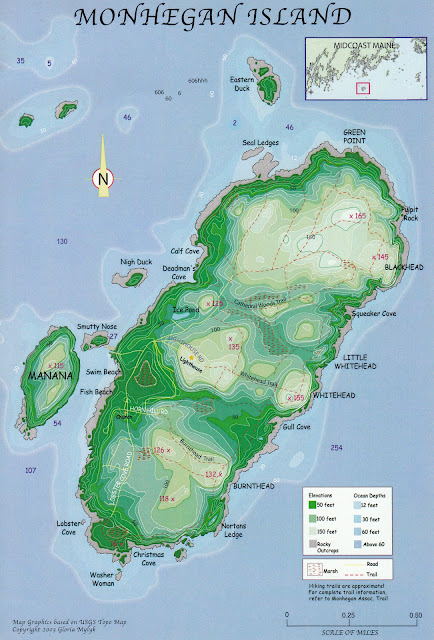
Copyright 2003 by Gloria Mylyk.  Used with permission.  Do not reproduce without permission.

I have been telling people for the past few years that one of these days I am going to write about Monhegan Island. After visiting the island three times this summer, I am finally making good on that promise. My thanks and appreciation go out to Ruth Grant Feller, Holden Nelson, Joan Rappaport, Stan and Marion Gurspan, and many others for their stories and willingness to share them with me.
__________ 

Every summer since 2001 my wife and I have been spending time on Monhegan Island. This year we could not have picked a more delightful time to go. After a cold and very wet spring followed by a stormy early summer with its murderous heat, the island was on the threshold of glorious weather when we arrived in early August. It was equally beautiful later in August when we made a day trip to the island with our son Ian, who had not been there in five years, and his wife Katie who had never been to Maine. Finally, our friend Becky Parsons, who was visiting from Virginia, joined us for another day trip this past week. The summer season was over and there were fewer visitors milling about. The local lobstermen were preparing their traps for the beginning of their season on October 1.

In Orhan Pamuk’s short essay “The View,” one of his frequent contributions to the Turkish political humor magazine Oküz [Ox], he describes a horse carriage ride he and his young daughter shared around Haybeliada, one of the Princess Islands in the Sea of Maramara, near his native Istanbul. Pamuk has spent many of his summers since childhood on this island and he wanted to share it with his daughter and to see it fresh through her eyes. At one point the carriage pauses at the head of a precipitous cliff where they were able to enjoy the broad panorama. “Beneath us there were the rocks, the sea, and rising out of the steam, the other islands. What a beautiful blue the sea was, with it the sun sparkling on its surface: Everything was where it should be, gleaming and immaculate. Before us was a perfectly formed world.” They admired the view in silence and wondered what made it so beautiful and appealing. “Perhaps because we could see it all. Perhaps because if we fell off the edge we would die. Perhaps because nothing looks bad from a distance. Perhaps because we’d never seen it from this height.” I have a similar feeling every summer as we anticipate our annual sojourn on Monhegan Island, a small island roughly a mile and a half long and a half-mile wide situated twelve miles off the coast of Maine, in Muscongus Bay.

Like one of this year’s visits, many of our Monhegan adventures begin with a night’s stay at the Hotel Pemaquid beautifully situated adjacent to the Pemaquid Point lighthouse which appears on the verso of the Maine state quarter. We frequently stay here the night before our departure for the island because it is just a short drive to the New Harbor wharf where we catch the morning boat out to the island. From this lighthouse on its rocky prominence we can often see Monhegan shimmering on the horizon in the early evening light as our anticipation of our visit begins to grow. From there we can also see Outer Heron Island, the White Islands, and Damariscove Island to the southwest, all of which were British fishing outposts beginning in the early 17th century, as well as many of the other 70 or so islands that populate Muscongus Bay - Western and Eastern Egg Rock, the latter being the southernmost nesting area for the Atlantic Puffin; Franklin Island with its own lighthouse. Farther to the east are the Georges Islands, among them Thompson, McGee and Burnt Island; and Benner and Allen islands, which belong to the estate of the late Andrew Wyeth who painted there each summer until his death in January 2009. And there, farther out to sea, is solitary Monhegan Island. Charles Jenney, an early chronicler of the island’s history, called it “The Fortunate Isle.” I am fortunate to visit it as often as I do (three times this summer!). I can’t think of a better way to describe it. I look out at it and I am reminded of Pamuk’s essay . . . “Everything was where it should be.”

I have previously posted brief accounts of my earlier experiences on and impressions of Monhegan Island, but there are still some interesting details I would like to share with you. On past visits to the island I have had some delightful conversations with the island’s current historian who has been coming to Monhegan since she was a toddler over 80 summers ago, and she has filled me in on the island’s history far beyond anything I already knew. Our innkeeper at the Monhegan House, where we always stay when we are on the island, has been a wonderful source of information, anecdotes, and scuttlebutt as his family has also been associated with the island since the early 1920s, and he has been coming to the island since he was a kid. I have chatted with full-time islanders and those who have been coming for summers dating back almost fifty years. Also, I have done reading and studied records in the island library to fill in some of the empty places. Monhegan Island has a very rich history, far more than I can share with you here. But here are a few salient thoughts (random and otherwise) about this most fortunate of isles.

Monhegan is one of the very few permanently inhabited offshore islands in Maine. The English explorer John Smith, who first named this region “New England,” arrived in the island’s harbor in 1614 and archeological evidence on Manana, the small treeless and whale backed island which provides protection for the anchorage, suggests that seafarers of one sort or another have been on and around the island for at least a thousand years. Although fishermen have used the island as a base of operations for centuries, permanent settlement did not commence until circa 1780 with the arrival and residency of the Trefethren, Starling and Horn families. The earliest tombstone in the island cemetery on Lighthouse Hill belongs to an infant who was born and died on the island in 1784. A few homesteads and their out buildings were constructed along with several fish houses along the harbor’s rocky edges and its two small sand beaches. Several of these fish houses are still standing and in use in some fashion today. A village of sorts was beginning to take shape on the island as members of the three families began constructing new homes and farms. It followed no plan as it developed; its austere buildings arose where they proved to be most practical for their purpose. In December 1822, the Province of Maine separated from Massachusetts and joined the Union, although Monhegan was retained by the Commonwealth. The three original families purchased all of Massachusetts’ remaining island interests for $200 in July 1823 and the island was granted to the new State of Maine. The federal government appropriated money to construct a lighthouse in 1822 and the original tower was situated 175 feet above sea level. It was razed in 1850 and replaced with the current structure. The light was automated in 1960.

The island was established as a “Plantation” - an unincorporated community in Maine - in 1839 (later within Lincoln County) and its population began to grow in the mid 19th century as new families arrived and purchased parcels of land from the original owners. New houses and barns were constructed and by 1850 there were fifteen households on the island. An island school house was constructed in 1847 and the school, segregated by sex, was established the following year. Besides its use as a classroom, the school house has long hosted other island events such as dances, shows, lectures, and various public meetings.

The federal government purchased a small tract of land on neighboring Manana island and in 1855 a fog signal keeper’s house was erected and a 2500 pound hand-wrung bell was installed (the bell is now on the top of Lighthouse Hill). A foghorn was installed in 1870,and a steam whistle in 1876 to replace the horn. A new and improved horn was installed the following year to replace the whistle. A compressed air siren was finally installed in 1912. Today the lighthouse and the fog signal (also fully automated) are known by sailors and navigators up and down the coast of Maine.

Between 1850 and the 1870s the population of Monhegan grew from 72 to 185 residents and fishing and farming remained the major means of subsistence. A non-denominational community church was constructed in 1880 and the islanders were ministered to by visiting members of the cloth during the summer months. A minister from the mainland came one weekend each month during the winter, a practice that continues to this day.

The world beyond Muscongus Bay discovered Monhegan during the last quarter of the 19th century. In 1877, Sarah and Wilson Albee purchased half interest in a house formerly owned by the Trefethren family and opened the Albee House, the first boarding establishment on the island. It eventually became the current Monhegan House, the island’s first hotel. Life on Monhegan was changing. Most of the farms and pasture land fell into disuse by the turn of the century; there was little livestock left on the island and many of the few remaining barns began to disappear. The farmland and pastures were eventually reclaimed by dark spruce woodlands. Monhegan was nothing more than a small weather-beaten fishing village.

The late 19th century also signaled the genesis of a flourishing artist community on Monhegan. By 1890, the Albee House was popular with a growing number of artists while still others were taken in by island families. The English born and Boston-based artist and photographer S.P. Rolt Triscott and his student Sears Gallagher, a promising artist in his own right, arrived on the island in 1892 and stayed at the Albee House. Triscott returned again the next year and purchased a house not far from the Albee House and began a long relationship with Monhegan that lasted until his death on the island in 1925 (he is buried in the island cemetery). George Everett, another artist, came to live year round on the island in 1896 and turned speculator, purchasing island real estate from the locals and platting building lots on Horn’s Hill, on the village’s southern reach. Gallagher continued to summer on the island for the next six decades as more Boston artists followed in Triscott’s footsteps. Eric Hudson first noticed the island in 1897 while sailing up the Maine coast from Boston to Mount Desert Island farther Down East. He returned the following summer and built a cottage and continued to paint on the island. Soon artists from as far away as Philadelphia, New York and Boston were traveling by train to Maine and then catching a coastal steamer destined for Monhegan.

Robert Henri and members of the Ashcan School in New York City, known primarily for its urban realism, first came to the island in 1902 and they continued to make annual visits during the summer months. “It is a wonderful place to paint,” Henri writes. “So much in so small a place one could hardly believe it.” Now the artists focused their talents on Monhegan’s varied landscapes and the powerful seascapes that surrounded the island. The Old Lyme Colony painters from Connecticut arrived in 1908, staying at The Influence, one of the oldest surviving buildings on the island (circa 1820s). Soon other noted artists were associated with the island.

The artist Rockwell Kent first came to the island with Robert Henri. Finding Monhegan to be the “land of promise,” he subsequently purchased a piece of land platted by Everett and built a small cottage where he wintered on the island in 1906-1907. He built another cottage for his mother at Lobster Cove, on the southern end of the island, in 1908. Since April 1968 it has belonged to Jamie Wyeth who still comes to the island frequently to paint. (The Farnsworth Art Museum, in nearby Rockland, Maine, is featuring an exhibit this year focusing on Kent’s and Wyeth’s long association with Monhegan.) Kent, who continued to do manual labor and work on construction projects on the island, also built another small studio in the village in 1910 and operated a small art school there for a time. “Truly I loved that little world, Monhegan, “Kent wrote. “Small, sea-girt island that is was, a seeming floating speck in the infinitude of sea and sky . . . .” He also admired the islanders. “I envied them their strength, their knowledge of boats and their familiarity with that awesome portion of the infinite sea. I envied them their worker’s human dignity . . . .” The locals went about their work and left the artists and other visitors to tend to their own. Kent finally left Monhegan in 1953 and James Fitzgerald, an artist long connected with the area around Monterey, California, later used Kent’s cottage and studio into the early 1970s and painted some of his most interesting work there. One cannot think of Monhegan without conjuring up the works of Kent, Triscott, Gallagher, Henri, Fitzgerald, George Bellows, Edward Hopper, Reuben Tam, Andrew Winter and a host of other artists. Three generations of Wyeths have also painted on Monhegan.

By 1910 new summer cottages had been built by artists and others as the land of the original three families was being “gobbled up” by newcomers. By this time a second island hotel, the Island Inn, was established on a hillside facing the harbor and the wharf which still serves the island today. Kent described the two hotels as “big barn-like things, exteriorly as uninviting as their tasteless insides warranted. But what are we to expect, we touring picture painters and summer tourists and visitors - ‘rusticators’ - they call us. Don’t we invite just such monstrosities for our convenience? Don’t they, perhaps, match us?” Soon the summer community began to outnumber the permanent island inhabitants. The village was developing with the expansion of the unimproved roads (glorified paths actually), the establishment of a post office and regular mail service by boat from Port Clyde (originally known as Herring Gut), and the opening of various shops catering to the growing island population. Ice required for refrigeration of food was cut from a small island pond during the winter and stored in an adjacent ice house. The cutting and storage of ice continued until the early 1970s when electricity came to the island replacing gas and kerosene.

Many of the island residents, both permanent and summer rusticators, joined the visiting artists in celebrating the tercentenary of John Smith’s landing on the island, in 1914. This was the first golden era of life on Monhegan. Unfortunately, the advent of World War I that year brought this era to a quick end as life on the island returned to that of a relatively quiet and secluded fishing village throughout the war years. It did not remain so for long, however, and several new houses and cottages were constructed in the early 1920s. With a further increase of the postwar summer population came more work for the year round population of approximately 140 who kept themselves busy laying in more food and supplies and opening up and taking care of the summer cottages. More artists, such as Abraham Bogdanov and Mary Townsend Mason, frequented the island. A small village library was constructed and opened in 1930 and is still operated by a Library Association. Next to the village post office was “the Spa, a small soda fountain with a bingo parlor and recreation hall upstairs. Despite this new lease on life, new construction on the island slowed during the 1930s due to the long-term effects of the Great Depression.

The year-round population in 1940 had fallen to around 70, and this number dropped even lower during World War II when several eligible island men went into the military. Luckily all returned home safely although two were prisoners of war for a time. The island was on a war footing as the entire island was blacked out throughout the war and the Coast Guard patrolled the waters around the island and posted a sentry on the headlands on the eastern side of the island (the highest cliffs on the coast of Maine where I frequently go to “look toward Portugal”). Very little land was purchased during the war and there was almost no new construction of summer cottages.

Some new construction occurred on the island beginning in 1947 and life was returning to normal by 1950. Summer visitors were returning in increasing numbers and several artists began looking for or constructing cottages and studios. Monhegan also underwent an artists renaissance after the war. Andrew Winter, a native of Estonia who first came to Monhegan with Jay Connaway in the 1920s, returned to the island with his artist wife Mary, in 1940. Both lived and painted year round in a house near the island wharf until Andrew died in 1959 (his widow sold it in 1963). Like Rockwell Kent before him, Winter did odd jobs around the island and lobstered from his dory. It was also after the war that the new Monhegan House developed a close association with the Ashcan School in New York and hosted a number of artists visiting the island during the summer.

The years of postwar prosperity brought with them the possibility that the island might become the target of uncontrolled development and quickly outgrow its ability to sustain a way of life so many - the island’s permanent residents and summer visitors alike - had come to appreciate. To preserve the island’s unique character, Ted Edison, the son of Thomas Edison and a regular summer resident who is also buried on Lighthouse Hill, and a number of like-minded individuals established the Monhegan Associates, Inc., in 1954, to protect the island from over-development. It eventually purchased almost 500 acres of undeveloped land outside the village with the intention of maintaining its almost pristine natural state in perpetuity.

Today Monhegan Island remains much as it has been for many years. Once the summer residents and visitors leave in late September, the island is again a quiet fishing community. Unlike other lobstering operations along the coast of Maine, Monhegan’s lobstermen have chosen to fish only during the late fall and winter months, setting their traps with a great deal of ceremony on October 1 (until recently they waited until December 1), and finally pulling them for the season, typically at the end of June. While buyers do come to the island from time to time, there are no facilities for processing or marketing the catch on island and so it is transported to Port Clyde and Rockland, on the mainland. The rest of the year lobstermen find other pursuits to keep them busy. Island life in these northern climes always requires constant care and maintenance of the village buildings.

Come June the artists and summer people begin to return to the island to open their cottages and studios after a long winter off-island. Soon daily boats operating out of Port Clyde, New Harbor and Boothbay Harbor are docking at the wharf and disgorging flocks of daytrippers and others who have come to hike the island’s miles of nature paths, to paint and take photographs, or otherwise enjoy the peace and quiet of this secluded and most fortunate isle.

So, when I stand on the mainland and stare out at Monhegan Island, whether I plan to head out there the next day or not, I understand Pamuk when he describes the view from the rocky headland of Turkey’s Haybiliada Island. Everything does seem to be where it is supposed to be.

Sunday, September 23, 2012

The Longest Salute - Dispatches from Maine

Last week I was invited to present a lecture before the New Gloucester Historical Society to kick-off the fund-raising efforts for a new veterans monument to be located in Upper Gloucester village. I was honored to be asked to share these thoughts with my adopted hometown. What follows is the text of my remarks that evening in the town’s Meeting House.

What is the purpose of a veterans monument or memorial? I happen to live on the edge of our nation’s capital, a place that has its fair share of monuments and memorials to those Americans who served in the various branches of the armed forces, many of whom gave their last full measure of devotion to their country. There is the Vietnam War Memorial, that half buried black wedge etched with the names of thousands of men and women. Nearby, the Korean War Memorial with its larger-than life, cold steel combat patrol slogging toward the 38th Parallel and whatever fate awaited them. The long overdue memorial to those who served in World War II, that war to end all wars although we know, sadly, that this was not the case. Now that the last veteran of the Great War . . . World War I . . . has passed away, the nation is looking for a proper manner to recognize their wartime service. A bit too late? Some might think so. But not at all. It is never too late for that longest salute to all those who have served their country in times of war. And these monuments should not serve just as a memorial to those who died. We honor all those who served just as we celebrate all who returned home.

Spending the summer on the shores of Sabbathday Lake, right here in New Gloucester, I have read with great interest about the town’s efforts to properly recognize the almost 900 New Gloucester men and women veterans . . . going all the way back to the Revolutionary War, and right up to the present day . . . as well as the town’s long involvement in the military history of the United States. Since our visit last summer, the New Gloucester Historical Society, the Lunn- Hunnewell Amvets Post #6, and many other residents and business owners have expressed an interest in a Veterans Monument. With the very generous donation from Richard McCann and his family of land situated in Upper Gloucester village, the town now has an ideal location for an appropriate monument. I am pleased and honored to have been invited to speak here tonight to mark the kick-off to raise funds for the construction and long-term maintenance of the New Gloucester Veterans Monument.

It is important that each generation of citizens understands the sacrifices of the generations that came before. Those of us who have not experienced the dangers and deprivation of military service, whether it be in wartime or not, must try to better understand what others have endured in the defense of our nation.

Growing up I was always curious about my dad’s army service during World War II. I remember, as a kid, asking him. “Dad? What did you do during the war?” I imagine I was like many young boys my age when they first learned that their fathers had served in the military during World War II. My dad would occasionally share some of his war stories although I was perhaps too young to understand just what he was telling me, or just how painful these memories might have been for him. Sons look up to their fathers as heros. I did. That war was still fresh in many memories; it was not that many years earlier that Dad and his buddies, following the massive D-Day invasion, were slogging their way across northern France in late 1944, slowly pushing the Germans back to their own border. Dad never really went into many details about the war, or exactly what he did, but there were a few stories he shared, and I still remember them as clearly now as the day he first told them to me.

Perhaps the most vivid of these, the one that still stands out in my own recollections of my childhood, was Dad’s participation in the Battle of the Bulge, the Ardennes campaign, the greatest land battle ever fought by the military forces of the United States between December 16, 1944 and January 25, 1945. This great battle halted the final Nazi juggernaut to defeat the Allies and turned the tide of war against the Germans who would surrender just six months later.

I have been thinking of these stories more recently, especially after Dad passed away almost three years ago. Dad had served in General George Patton’s Third Army during the northern European campaign, in 1944-1945. Not long ago I visited my dad’s grave for the first time since his memorial service at the Florida National Cemetery. It was my first opportunity to see the inscription on the marble tablet marking the niche containing his ashes. It was then and there that I learned for the very first time, and much to my complete surprise, that Dad had received the Bronze Star, the fourth highest decoration awarded for distinguished, heroic or meritorious achievement or service in combat. He really was a hero even if not that many people, including his son, knew it.

A few days later my wife and I visited with one of the last surviving members of Dad’s unit. I first learned about Harry a few years ago when I was doing some online research on the Ardennes region of eastern Belgium and Luxembourg. I came across a photo essay on the area by a veteran of the Battle of the Bulge who had returned to visit the places he knew from the war. Many of the places and events he described seemed very similar to the ones my dad had told me about when I was a kid. I called Dad up and asked him whether he knew the guy who had posted the photos. “Why sure,” he said.” Harry was one of my closest buddies during the war.” They had not seen each other since the early days of 1945, in the immediate wake of the battle, and, as it turned out, they lived only a few miles apart in Florida. Dad gave Harry a call and over the next few months they renewed their old friendship. Harry and I also exchanged occasional notes and we planned to meet when my travels took me to Florida. I regret that I was not able to meet with Harry when Dad was still alive, but over lunch I told his old army buddy what I knew of Dad’s wartime exploits and Harry was able to fill me in on many more details. He answered a lot of questions I had about that chapter of my dad’s life.

I am sure my dad’s story is like those of many others who were called to serve their country in a time of war . . . like many of the almost 900 individuals whose names will eventually appear on the New Gloucester Veterans Monument. Dad was drafted into the US Army in early 1943, just a couple months shy of his 19th birthday. He left his native Michigan and did his basic training at Fort Jackson, South Carolina, where he was eventually assigned to the 104th Infantry Regiment of the 26th Infantry (Yankee) Division. This division was originally formed out of Massachusetts National Guard units for service in World War I as part of the Allied Expeditionary Force, and the division and regiment have had a long and distinguished history. In World War I, the 104th became the first US Army regiment to receive the fourragère of the French Croix de Guerre after showing “fortitude et courage” in repelling a German attack at Aprémont on April 10-13, 1918. These words have been the regiment’s motto ever since. Dad underwent training at Fort Jackson, and later at Fort Campbell, Kentucky, and participated in maneuvers in Tennessee the winter of 1943/1944.

Departing Fort Jackson, in August 1944, upon completion of basic combat training, Dad and Harry and their unit were sent to the huge Camp Shanks - “Last Stop USA” - in New York’s Hudson Valley. It was time to go to war. Dad would serve until his discharge in early January 1946 and he and Harry and their buddies would grow up fast in those years of hardship not knowing if they would survive. A lot of the brave men who went to war never came home. Dad and Harry were lucky.

After Camp Shanks the 26th Infantry Division embarked from Fort Miles Standish, at Boston, in late August 1944, crossing the Atlantic directly to Cherbourg, France where it landed on September 7, 1944, some three months after D-Day. The division was first attached to III Corps, Ninth Army at the Valognes staging area where it underwent extensive combat training and was assigned to local security duties along the Cherbourg peninsula and the Normandy beachheads used on D-Day.

Following this training, the 26th Infantry Division was assigned in October 1944 to XII Corps in General George Patton’s Third Army which moved so quickly across northern France that it soon out distanced its supply line and had to slow down its advance. The 26th Division departed Normandy and caught up with Third Army in its operational area in the Lorraine region in northeastern France, the same area where the division and the 104th Regiment had served with distinction in World War I. There it took up a defensive position on Third Army’s right flank near Salonnes. It was here Dad and his 104th Infantry Regiment had their baptism under fire in an action against the German 11th Panzer Division in the Moncourt Woods, in late October 1944. This is where all the combat training paid off as these green American soldiers went up against a seasoned German division which had been in combat since 1940 and saw action in the Balkans and along the Eastern Front before it was sent to France in early 1944.

During that first week of November 1944, Third Army prepared to launch a large-scale offensive along the front near the German border. The first major offensive action by the 26th Infantry Division was against German positions in and around Vic-sur-Seille on November 8. The 104th Regiment advanced on the left flank toward Hampont and the Houbange Woods, and it captured Bennestroft two days later. The regiment proved it was up to the task assigned to it and it added a second regimental Croix de Guerre to its colors. 

The division continued to advance on the German border in late November with the 104th Regiment crossing the Canal du Rhin au Marne on December 1. A few days later the regiment reached the Maginot Line, a system of concrete fortifications constructed by the French near the border with Germany after World War I. There the regiment launched an attack against heavy German resistance as part of Third Army’s planned assault into Germany.

Following this assault, Dad’s regiment was transported to a rear area near Metz, in France, for some much needed R&R. But there was no rest for the weary. During the early morning hours of December 16, the Germans launched a surprise major counteroffensive through the Ardennes of Luxembourg and eastern Belgium in a last ditch effort to divide American and British forces advancing toward Germany. The Germans quickly advanced westward creating a large “bulge” in the Allied lines while never actually breaking out. Third Army was forced to suspend its offensive in the Saar Basin and reposition its forces in order to address this new German aggression. All units of Third Army were thrown against the southern shoulder of the German bulge into the Allied lines. The 26th Infantry Division, was transported from Metz to the vicinity of Arlon, in southeastern Belgium, in mid December 1944 where it launched an assault northward through western Luxembourg to help relieve American forces under siege at Bastogne, Belgium.

By December 23 the 104th was advancing through the hills and gorges of the Ardennes toward the Sûre (Saar) River and it met heavy Germany resistance throughout December 24 and on Christmas day as it continued to advance. There was intense combat on Christmas morning as the 104th moved up to Esch-sur-Sûre to establish important bridgeheads over the Sûre. The remainder of the division continued its northward advance in the closing days of 1944 in an effort to break the German siege of Bastogne. Dad and his unit remained in Esch-sur-Sûre for several day securing the bridgeheads and its regimental headquarters. It was here that Dad won his Bronze Star.

Heavy snow and German resistance stalled the American advance in early January 1945 and the 26th Division remained in northeastern Luxembourg and eastern Belgium for almost a month, until the German offensive had all but collapsed. By January 25, 1945 the German counteroffensive through the Ardennes was over and Third Army resumed its eastward advance from northern Luxembourg into Germany. Never able to enjoy their relief from front line action, the 26th Infantry Division had finally made it into Germany and it would not leave until the job it was given was completed.

By early March 1945 when it resumed the offensive, Third Army was already well on its way to the Rhine River and the heartland of Germany against scattered yet heavy enemy resistance. Once it crossed the Rhine in late March, resistance diminished and the division advanced quickly south of Frankfurt to the bridgeheads over the Main River east of that city. On April 15 the entire division was approximately 10 miles from the Czechoslovakian border in southeastern Germany where its advance was intentionally halted.

It was here that the war took on an entirely different meaning for Dad and his buddies. Perhaps they did not realize it at the time. One expects to encounter death and destruction when engaged in combat. But it was there, in the final weeks of the war, that death and the cruelties of war took on a different and more sinister dimension. The XII Corps of Third Army, including the 26th Infantry Division, was tasked with the pacification of eastern Bavaria, and it quickly advanced southward toward the Danube River and the Austro-German border near Passau. The division moved into Austria in early May and elements of the division took Linz on May 4. On the following day divisional units overran the Gusen concentration camp, part of the Mauthausen camp complex, east of Linz, and on May 6 it continued north into Czechoslovakia. Third Army had moved farther east than any other American unit in the European theater. This is a part of the war my dad never told me about. It was at Gusen that young American soldiers witnessed man’s inhumanity toward man up close and personal. Even years later, when I was spending my professional career investigating and prosecuting the perpetrators of Nazi war crimes and atrocities, my dad never told me about this part of the war. I wish he had, but I understand why he didn’t.

Germany surrendered unconditionally on May 7 and hostilities officially ended on May 9. The following day elements of the 26th Infantry Division made contact with advanced units of the Soviet Red Army in the vicinity of Ceske-Budejovice, Czechoslovakia. Since the autumn of 1944 the 26th Infantry Division had been in combat for 210 days; the 104th for 177 days. But the war was not over; the 26th and the 104th returned to the area around Linz to train for eventual deployment in the Pacific. Luckily the war ended there before they had to go and finish the work begun in the forest and hills of northeastern France almost a year earlier.

When I was attending university in Germany in 1971-1972 I had an opportunity to visit many of the places where the Yankee Division and the 104th Infantry regiment had served with distinction. During the war Dad had plotted the movements of his unit on various maps he had found along the way. He had also kept a small journal in his boot and I had all of these with me during my time in Europe. One of my German friends took a great interest in what I was doing and I told him the stories my dad had shared with me as a kid about his wartime service in Patton’s Third Army. It was then that Johannes told me that his own father had served in the 11th Panzer Division, the elite German unit my dad’s regiment first faced off against in northeastern France. We talked and it turned out the stories his father told him were very familiar to the ones I had heard as a boy. Twenty-five years earlier two young men . . . boys actually . . . one American, the other German, stared down the length of their rifles at each other. Years later their son had become friends. I met Johannes’ father. I’m pretty sure he and Dad could have been friends in another time and place.

I spent quite a bit of time in the area of northeastern France, visited the Moncourt Woods where Dad first saw combat, and then traveled throughout the Ardennes looking for the various places Dad had told me about. Recalling some of the more vivid stories about his time in Esch-sur-Sûre, I visited the town several times. On one visit I managed to identify the house in the rue de l’eglise where Dad and his buddies had bunked during that snowy Yuletide back in 1944. I knocked on the door to discover that the family to whom the house belonged during the war, still lived there and they gave me a tour and invited me to stay for coffee and cake. Later that evening I had dinner at the Hotel Ardennes, which had served as the regimental headquarters during the late stage of the Ardennes offensive. When I told the waiter why I was there, he brought me a bottle of wine and my entire dinner was on the house. The American liberators were still looked upon as heros. And so were their sons, apparently. I can’t think of a time I was prouder to be an American. Or for what my dad and his buddies had done years ago.

So it was a real treat to finally meet Harry only wishing that Dad had lived long enough to share that day with us. While Dad never really involved himself in veteran affairs and unit reunions after the war, Harry jumped in with both feet and even today, at age 89, he works hard to make sure younger generations never forget what he and Dad and so many like them did to preserve our way of life in this country. We remember and salute them all.

So why have I told you all of this? In Shakespeare’s The Tempest, Act 2, Scene I, we are told that “what is past is prologue.” We learn from the past. Time is long and therefore memories must be long to recall what has come before and its importance to what happens now and in the future. Just as it is important to remember the stories my dad told me about the war, and those that I learned about after he had passed away, it is important that all of us remember the stories we have been told. The names that will appear on the New Gloucester Veterans Monument will be fresh in the memories of some. Others less so, and some have been long forgotten. But not any more. Their names will now be engraved for present and future generations to see and reflect on. What happened to these people in times of war? We might not recall the details of their particular service. What they saw. What they did. But we should never forget their names. Never. The new Veterans Monument will stand as the longest salute to these honored men and women. Recall the words of Abraham Lincoln:

It is for us the living, rather, to be dedicated here to the unfinished work which they who fought here have thus far so nobly advanced. It is rather for us to be here dedicated to the great task remaining before us -- that from these honored dead we take increased devotion to that cause for which they gave the last full measure of devotion -- that we here highly resolve that these dead shall not have died in vain -- that this nation, under God, shall have a new birth of freedom -- and that government of the people, by the people, for the people, shall not perish from the earth.